Get to know your bill
Customers will receive a quarterly bill every 3 months. Your bill will outline any new charges, payments received since your previous bill, current account balances and any overdue amounts.
We have three types of bills:
- Residential bills apply to homes e.g. family households, share houses.
- Non-residential bills apply to properties such as businesses and sporting facilities.
- Rural bills apply to properties that are located outside urban townships. Rural properties connected to pipelines that transfer water between urban township will usually be subject to a Water Supply Agreement as we can’t guarantee the pressure or quality of the water we supply.
Your bill explained
Learn about each part of your bill by clicking on the animated dots on the bill below. You can choose to view either page 1 or 2.
Is your bill more than you expected?
Your quarterly water bill may sometimes be much more than usual due to a leak or unexplained high water meter reading.
If we complete a meter read at your property that is a lot higher than usual, we’ll notify you as soon as possible, either through SMS, email, or a letter in the mail.
We also have a range of practical options to help ease the pressure. Find out how we can help.
Frequently asked questions
Find the answers to the mostly commonly asked questions about our prices and charges.
Our bills cover the cost of having quality water ready and available in your kitchen, bathroom, laundry and garden. And to have the sewage from your toilet, sinks, showers and basins taken away. We always aim to keep them as low as possible.
If you’re an average homeowner, connected to both water and sewerage, this costs just $3.75 a day*. That’s less than one takeaway coffee!
And if you’re a renter, you only pay for your water usage – so that’s 77 cents a day*.
*Based on the average customer using 140,000 litres of water a year, or 384 litres a day.
This amount is based on the amount of water you use. An average customer uses 142 kilolitres (142,000 litres) of water each year.
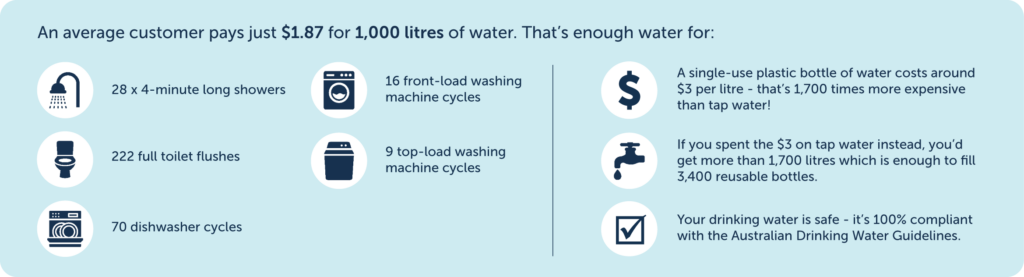
We charge $1.87 per kilolitre which covers the cost of treating your water to ensure it’s safe to drink and use. Therefore, the average customer pays just over $265 a year for their water.
This is a fixed charge for each property owner. If you own your home, you’ll pay about $197 in water service charges.
This helps us cover the cost of maintaining and upgrading our water supply network including reservoirs, pump stations and treatment plants.
It also helps us maintain and renew nearly 2,000 kilometres of water mains. If we laid them end-to-end, they’d stretch from our coastline to Mount Isa.
This is a fixed charge for each property owner connected to our sewerage network. If you own your own home, you’ll pay around $889 a year.
This helps us cover the cost of taking away and treating your sewage. For the average household, this waste would fill the equivalent of 30 big brown bins every week. Just imagine having to dispose of that yourself!
It also helps us to maintain and upgrade our sewerage system including pump stations, treatment plants, lagoons and biosolid facilities.
And it helps us to maintain and renew more than 1,000 kilometres of sewer mains. If we laid them end-to-end, they would stretch from our coastline to the Queensland border.
Our Rural Water Surcharge aims to support water efficiency across some of our higher water users.
We introduced the surcharge during the Millenium Drought to stop the uncontrolled growth in rural water consumption and to ensure our supply systems could remain sustainable into the future.
With water security at the forefront of customers’ minds at the time, the surcharge was viewed by the community as a way of encouraging water efficiency and sustainable farming practices while delivering water security for all customers.
The surcharge was established by allocating rural customers a maximum annual usage limit. Any water use above the allocated limit attracts a surcharge in addition to the water usage charge.
Customers can apply to increase their limits subject to conditions including:
- There are no significant constraints on the water supply system.
- They are pursuing water conservation measures or using alternative water sources.
- They have experienced a change in their use of the land or a legitimate uncontrollable change in their water use.
- They have paid the rural water surcharge for exceeding their limit in the three previous financial years.
- They haven’t received an increase in their limit in the previous three years.
New rural customers have a maximum annual usage limit of 500 kilolitres. There are no grounds for review of this limit.
All customers who have access to our water supply system or sewerage system are required to contribute to the cost of maintaining these systems.
Fixed service charges apply regardless of whether your property is physically connected or not. If a water or sewerage main runs past, through, or near your boundary, your property is legally designated as ‘serviced’ land. Even if your property is not connected to the services, the infrastructure exists and must be maintained to ensure it remains reliable.
These charges are known as ‘availability’ charges or ‘unconnected’ service charges. It’s important to remember that all properties benefit from the presence of water mains for firefighting purposes. All properties also benefit from the presence of sewerage infrastructure due to the reduced environmental and public health impacts of septic tanks in urban areas.
If your property isn’t connected to water, but the service is available, you won’t pay any usage charges, you’ll only pay the water service charge.
If your property isn’t connected to the sewerage system, but the service is available, you’ll pay a sewerage service charge. This is a reduced charge – around 70 per cent less than the charge that applies to properties that are connected to the sewerage service. The charges have been approved by the Essential Services Commission who is the independent industry regulator.
Did you know?